
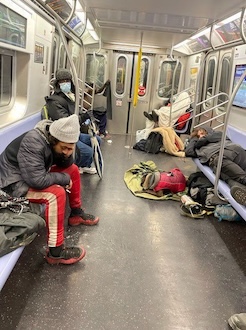
Homelessness in New York has reached the highest levels since the Great Depression
In 2024, the HUD reported that homelessness in the United States broke the 2023 record with 771,480 people nationwide experiencing homelessness. In New York it’s reported that there were more than 158,000 homeless which is about one fifth (1/5) of this country’s problem. Most of the homeless reside in New York City. These are the highest levels New York has experienced in nearly 100 years.
This equates to 8 out of every 1,000 being homeless, a ratio that was higher than every state with only District of Columbia and Hawaii being higher. The HUD also cited the reasons for the homeless crisis in New York worsened due to eviction proceedings, lack of affordable housing, increased rents, and the influx of asylum seekers, among other key factors like mental illness, addiction, and job loss. Mental illness and addiction cannot be cured only treated daily for a person’s lifetime. This often gets overlooked by many states including New York exploring solutions to the homeless crisis in this country.
Simply put, unaffordable housing has plagued New Yorkers for years and it doesn’t seem to be getting any better. In a recent article, it is reported that 30% of New Yorkers spend greater than 50% of their income on housing. The rule of thumb according to the federal government is that no more than 30% of income should go towards rent. New Yorkers seem stuck between a rock and a hard place as rents continue to rise faster than their incomes. Below are some other basic facts about NY homelessness:
- In November 2025, 101,978 people slept in emergency NYC shelters. Thousands more (there is no reliable number, as the annual HOPE estimate is deeply flawed) slept unsheltered in public spaces, and more than 200,000 people slept temporarily doubled up in the homes of others. It can be estimated that more than 350,000 people were without homes in NYC in October 2025.
- In November 2025, 68 percent of those in shelters were members of homeless families, including 34,393 children.
- More than 156,000 NYC schoolchildren experienced homelessness at some point during the 2024–2025 school year, representing one in eight children attending city schools.
The last two (2) bullet facts about children / schoolchildren are not only shocking, but it’s also abhorrent, nauseating, and should be completely unacceptable to NY city officials. No one should be homeless let alone a child.
Many people seem to be aware that one primary reason that people become homeless is due to lack of affordable housing. Other primary contributors are addiction, mental illness, domestic violence, job loss, and lack of job and social skills. New York’s homeless crisis has intensified in the last decade because between 1996 and 2017 the state discarded around 1.1 million affordable housing units due to negligent and incompetent city officials. A decision was made to outsource housing and services to 14 nonprofits who receive around $1 billion in annual funding. I have nothing against viable, highly functioning, cause worthy, and trustworthy nonprofit organizations, but why take away the housing units? This crippling blow has been dealt and with rising construction costs and exorbitant rent increases the outlook is bleak now. New York State Comptroller Thomas P. DiNapoli is quoted as saying “New York has long had a housing affordability crisis, and more families are running out of options and ending up on the street or in shelters,” DiNapoli said. “Many of the tens of thousands of asylum seekers that came to New York had no place to stay and drove up spending and a large portion of the growth of the homeless population. But let’s be clear, this isn’t just a New York City problem, it is impacting communities all over the state. New York needs to examine how it’s using current housing resources while taking more action to address this urgent situation.” The city continues to subcontract services to stop the hemorrhaging, while city officials have yet to outline their vision and plan to address the crisis. What about a plan that includes permanent supportive housing and individualize services for addiction, mental illness, domestic violence, lack of job skills and job loss? With no imminent plan that includes a longer term solution in sight, the city managed to spend a staggering $3.8 billion dollars on DHS-contracted shelters and related services. The article goes on to say that the current system seems to prioritize bed count numbers versus moving towards a permanent housing solution. With a narrow focus and lack of accountability for city officials it’s no wonder that the homeless numbers are the highest in New York City since the Great Depression of the 1930’s. Last year both Governor Hochul and then New York City Mayor Adams both announced affordable housing proposals in their recent 2025 policy addresses. Reports indicate that $25 billion over five (5) years has been ‘allocated’ to create and preserve approximately 100,000 affordable housing units. Very little information was provided regarding other services that might be provided. Keep in mind (as previously noted) that New York lost over 1 million units over an 11-year period. According the ny.gov website key programs such as ERAP (Emergency Rental Assistance Program) and LRAP (Landlord Rental Assistance Program) were closed during 2023 and 2021 respectively. So, there is plenty of work and catching up to do before New York can reverse this negative trend.
If New York is going to start living in the solution versus being their own worst enemy, then obviously they need leadership who understand, care, and have the vision to focus on the big picture. That focus, energy and investment must go to permanent rather than temporary solutions that are tied to measurable outcomes. Outcomes that can be tracked and reported combined with service organizations and government officials being held accountable for the performance or lack thereof. Accountability is key and right now that is something that is clearly lacking.
A solution that doesn’t include outcomes such as job and permanent housing placements, success rates for addiction and mental illness treatment, family reunification, unemployment, and a life worth living (quality) for the homeless is no solution at all. The current short term/stop gap solution does not identity and treat the root causes. The rapidly rising homeless numbers, lack of affordable housing and rents rising faster than incomes, provide clear evidence that a lot of change is needed in the Big Apple.